

Pulse : How do you see a typical traveller’s journey in 2040? In what ways will this experience be similar to, or different from, those of today?
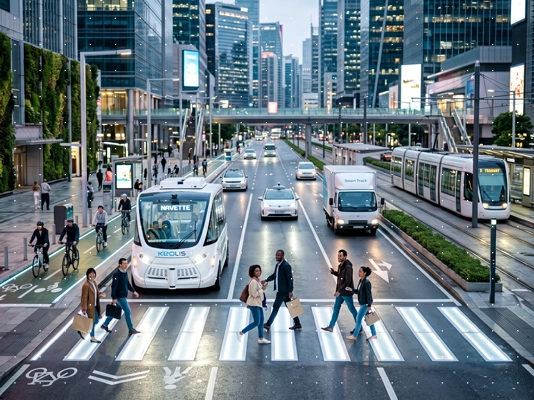
Alexis Jovignot : When you’re thinking about mobility in 2040, you’re already looking at what’s coming up in the forthcoming invitations to tender. 2040 may seem a long way off, but in terms of operation and maintenance contracts, it’s barely two contract durations away. In terms of the transport services provided, I wouldn’t expect a revolution. With urbanisation and cities becoming denser, we will still need high-capacity modes of transport – trains, metros, buses and light rail – to meet the travel needs of most people. Indeed, any local authority that wants to be ready by 2040 will have to start building a tram or metro line today. Where transport provision is likely to evolve will be in two areas: the energy transition, with the widespread electrification of all modes of transport; and the complementary use of different modes to serve less densely populated communities. We will need to invent new forms of mobility, and here I am a firm believer in autonomous mobility. The technology is ready. There will be robot taxis in Paris by 2040 – there’s no doubt about that – but I can’t see Keolis operating millions of robot taxis. On the other hand, autonomous shuttles could provide an appropriate solution for rural areas, outlying neighbourhoods or business parks at 5 am, for example. Their role will primarily be to fill out the existing service offering and bridge the remaining gaps in the network.
Julien de Labaca : I don’t think the way people travel will be fundamentally different. What has already been set in motion is being multimodal on the one hand – choosing different modes of transport depending on the day and our needs – and intermodal on the other – combining several modes during a single journey. After all, it will never be possible to run trains and buses everywhere, while car use is continuing to decline in city centres. One of the challenges in the coming years will therefore be to make journeys increasingly simpler and smoother. Today, in France, there’s still room for progress: passengers are still in doubt as to whether they can take their bike on the train, if they will find a free space in a cycle park, or if their on-demand transport (TAD) will turn up at the station, and, more broadly, how to get the right information effortlessly, and ideally in real time. I hope that by 2040 these issues will have been ironed out and that journeys will flow naturally, without any disruption or friction between different modes of transport: that everything will be seamless. In short: more service provision, definitely, but even easier to use!
AJ : In my view, from a transport demand perspective, passengers will experience several changes in the way they travel. The most significant is to do with the introduction of artificial intelligence. To plan their journey, passengers currently have to download an app, check timetables or get the information they need at the actual bus stop. But if the bus is running late, and the passenger has reduced mobility, for example, they won’t be offered any alternative solutions. AI can improve the clarity of information by providing contextualised, individually tailored details, bringing people a ‘mobility buddy’.
JdL : AI is a powerful tool, but we should bear in mind that today, 70 per cent of people find it hard to understand a transport network map. And that’s not just older people or those with cognitive impairments. That’s 70 per cent of the whole population! As a result, many functions may be made easier to use thanks to chatbots. And where the data is available, it could even be entirely conceivable to cope with the heatwaves such as those we had over the summer this year in France. The heat issue could be addressed by AI: imagine pedestrian or cycling trip planners that factor in the temperature or shaded areas depending on the time of day or the height of buildings. On that note, to power these systems, lots of good quality data needs to be generated, failing which AI won’t make any difference !